Dear Reader,
Eggs. I know.
You knew eggs were good for you before you could spell them. Protein, cheap, quick, the thing somebody made you when there was nothing else in the house. So I’ll skip the part you already have, and go to the part I didn’t — the part that had me back at the shop for another dozen.
What’s actually in one
A large egg comes to about seventy-seven calories. Six grams of protein, five grams of fat, and carbohydrate in quantities you’d need a decent laboratory to find.
The protein is the headline. When researchers want to rank how good a protein is, they need something to rank it against — and the thing they settled on was the egg. It scores 100. Everything else on your plate is marked against it, which I think is rather a nice thing to be.
Almost everything interesting is in the yolk. The white is mostly protein and water. For about thirty years we were told to bin the yolk and eat the white, which is like buying a newspaper for the plastic it comes wrapped in.
The cholesterol business
Let’s deal with it, because somebody always asks.
One large egg carries about 212mg of cholesterol. Next to most foods that’s an enormous number, and it’s why eggs spent a few decades in the naughty corner. Three or four a week, we were told, and no more.
That advice is gone, and it went quietly. Around the year 2000 the Department of Health and the British Heart Foundation dropped the limit, and the current position is that there’s no recommended number of eggs at all, as long as the rest of what you eat is varied. The British Heart Foundation puts it plainly: one or two a day is unlikely to be a problem for most adults.
Here’s what hadn’t been properly reckoned with the first time round. Your liver makes cholesterol. It makes it every single day, whatever you do. Eat more of it and your liver makes less. Eat less and your liver makes more. It’s a thermostat, not a bucket.
Two caveats, because you won’t get them from the egg marketing people.
The first is familial hypercholesterolaemia, an inherited high cholesterol that affects roughly one Briton in five hundred. That group is still advised to watch dietary cholesterol, and a good many of them don’t know they have it. The second is that a few studies have found a different picture in people with diabetes, and that question isn’t settled. If either of those is you, it’s a conversation for you and your GP, and not for a bloke with a blog and the kettle on.
One last thing the NHS does still say: cook them without piling on salt or fat. Frying can add something like half again to the fat content. Boiled and poached are the quiet heroes.
Choline, which I’d never heard of
This is the bit I came for.
Choline only went onto the official list of things humans need in 1998, when the American Institute of Medicine put it there. Nineteen ninety-eight. There are cars on my road older than that. Before then it was assumed we made enough of our own, and more recent work says we don’t, quite.
It does three jobs worth knowing about:
- It builds cell membranes — the walls of every cell you own.
- It’s the raw material for acetylcholine, which is the chemical your nerves use to tell your muscles to get on with it. Every time you pick up the kettle, choline had a hand in it.
- It helps move fat out of the liver, which is a job the liver would rather not be left to do alone. Run short for long enough and fat starts to gather there.
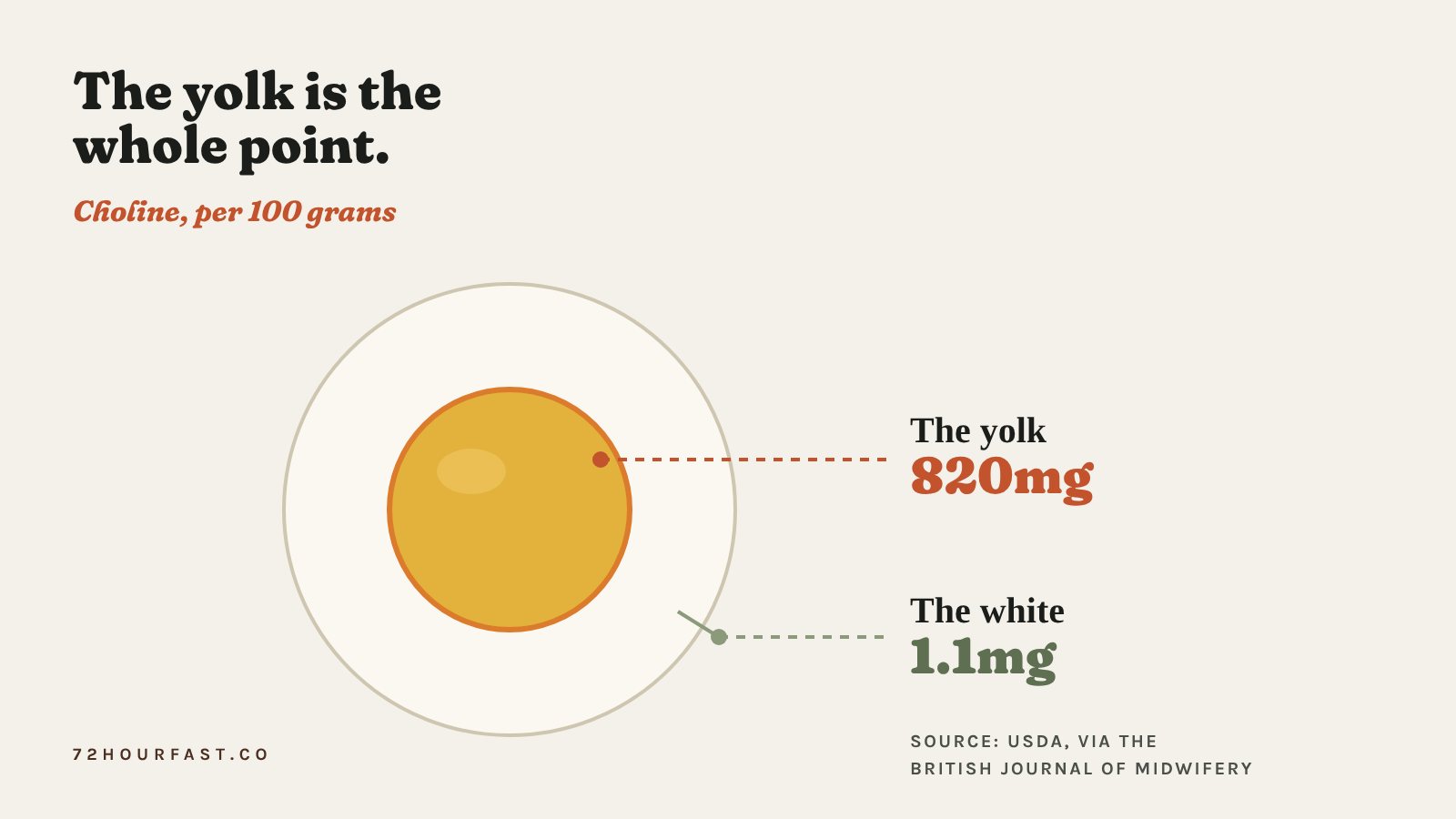
And it is all in the yolk. Not mostly. All. Weight for weight the yolk carries around 820mg of choline per hundred grams and the white carries about 1.1mg, which is the single most lopsided number I came across while reading about any of this. Thirty years of egg-white omelettes, and the good bit was going in the bin.
How much do you need? Europe’s food safety people settled on 400mg a day for an adult, 480mg in pregnancy and 520mg while breastfeeding. The UK, as it happens, doesn’t set a figure for choline at all. A medium egg carries somewhere around 144mg, so two eggs gets you most of the way to that European number before you’ve had anything else. The figures wander about depending on who measured what and how big the egg was, which is worth knowing before anybody quotes one at you as gospel.
Now the honest bit. When the European panel sat down to set a proper requirement, they couldn’t. There’s no reliable way to measure how much choline a person is carrying, so instead of a requirement they set an “adequate intake”, which is a polite way of saying this is roughly what healthy people seem to eat and nobody appears to be falling over. Average intakes run nearer 300mg. That’s under the mark, and under the mark is not the same thing as deficient.
So I’m not going to tell you that two eggs will sharpen your memory or mend your liver. I’d rather tell you what I actually did, which is read all that, decide the downside of eating more eggs was approximately nothing, and eat more eggs.
One group where it’s taken rather more seriously is pregnant women, which is why choline turns up in infant formula. If that’s you, it’s a conversation for your midwife. And while we’re there: please don’t fast while you’re pregnant. It’s in the Sensible Bit for a reason.
The other two hiding in the yolk
Lutein and zeaxanthin. Two antioxidants that make their way to the retina and settle there, which is about as targeted as food gets. The research links them to a lower risk of macular degeneration and cataracts. Not a guarantee, and not a reason to cancel the optician — but another argument for the yolk.
Why any of this is on a fasting blog
Because of how you come out of one.
Breaking a fast is the most under-taught skill in the whole business. The longer you’ve gone, the gentler that first meal has to be, and an egg is close to the perfect first thing: protein your body recognises, fat to slow it down, no sugar, nothing to spike. Soft-boiled, eaten slowly, half an avocado alongside if you’ve got one.
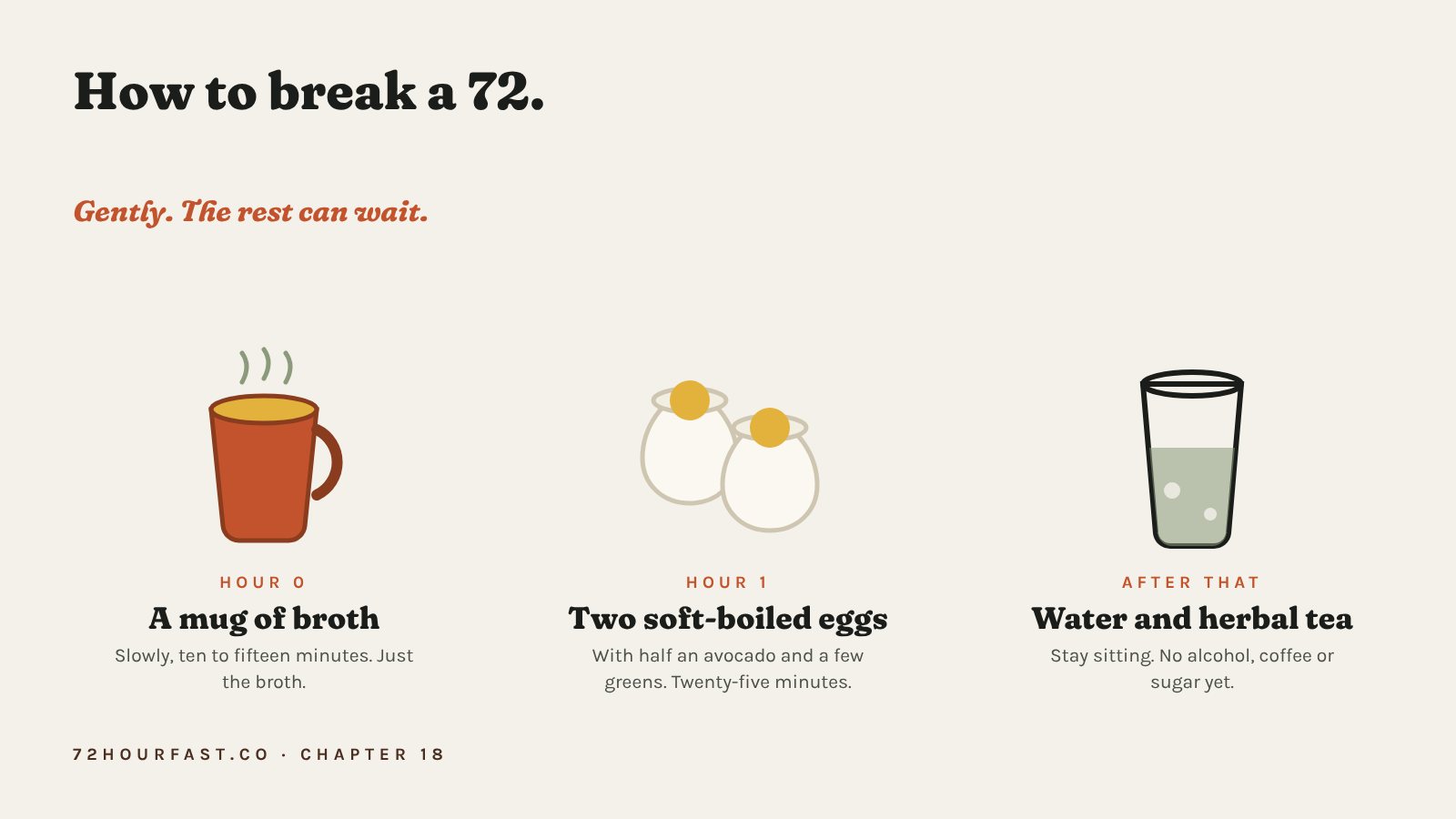
So there are six hard-boiled eggs in my fridge whenever I’m fasting. They cost about two pounds. Three, if they’re the posh ones. I’d call them the single most useful piece of fasting kit there is, and I’ve bought a lot of fasting kit.
They’re there for the day it doesn’t go to plan. I once broke a seventy-two on a kebab, standing up, at speed. That story’s in the book, and I’ve never paid that price again. And at hour fifty-six of another one, the phone rang with bad news about my stepfather, and I ended the fast at a motorway services on a shop-bought protein box — two boiled eggs and a sprig of spinach. I got lucky that day. Six in the fridge is how you stop needing luck.
Stop the fast. Eat the eggs. Get in the car.
Not all eggs are eggs
A hen kept in a shed and fed on grain lays a different egg from one that gets outside and eats what it finds. Same shell, different contents. Pastured eggs, or the omega-3 enriched ones, are worth the extra few pence. You’ll see it in the yolk before you read it on the box — the good ones are a deeper orange.
That’s eggs. I’ve gone on about them for longer than I meant to, which is what happens when something cheap turns out to be quietly brilliant.
Boil six on Sunday. Thank me on Wednesday.
Greg x
Where the numbers came from. The egg advice is the British Heart Foundation’s and the NHS’s. The choline intakes are the European Food Safety Authority’s 2016 opinion. The yolk and white comparison is United States Department of Agriculture data, quoted in the British Journal of Midwifery. Healthline’s write-ups on eggs and choline are a sensible general read, as is Dr Josh Axe on choline — read that one with your eyebrows at their usual height, as there’s a supplement shop attached.
If this was useful. The refeed in full is Chapter 18 of The 72-Hour Fast, which also comes with a free twelve-week PDF journal. If you’re starting out, the 7-Day Planner is free, and so is the timer.
This is a blog, not medical advice. Fasting doesn’t suit everyone — please read the Sensible Bit first, and talk to your doctor if you take any prescription medication.


Leave a Reply