First written in the diary, November 2017, under a title about swapping a prescription drug for a supplement. That version has been taken down for good. This is a different post about the same yellow powder, written in November 2026. Greg x
Dear Reader,
The old version of this post is not coming back, and you should know why.
In 2017 I wrote about replacing a prescribed anti-inflammatory with turmeric. I gave doses. I was pleased with myself. Somebody on medication could have read it and copied me, and that’s not a thing I’m willing to leave up. If you’re on something prescribed, the conversation about stopping it is with your GP and nobody else.
What I can tell you about is what I take, what it’s felt like, and what the evidence actually says. Including the bit where the evidence says it might be my imagination.
What I take
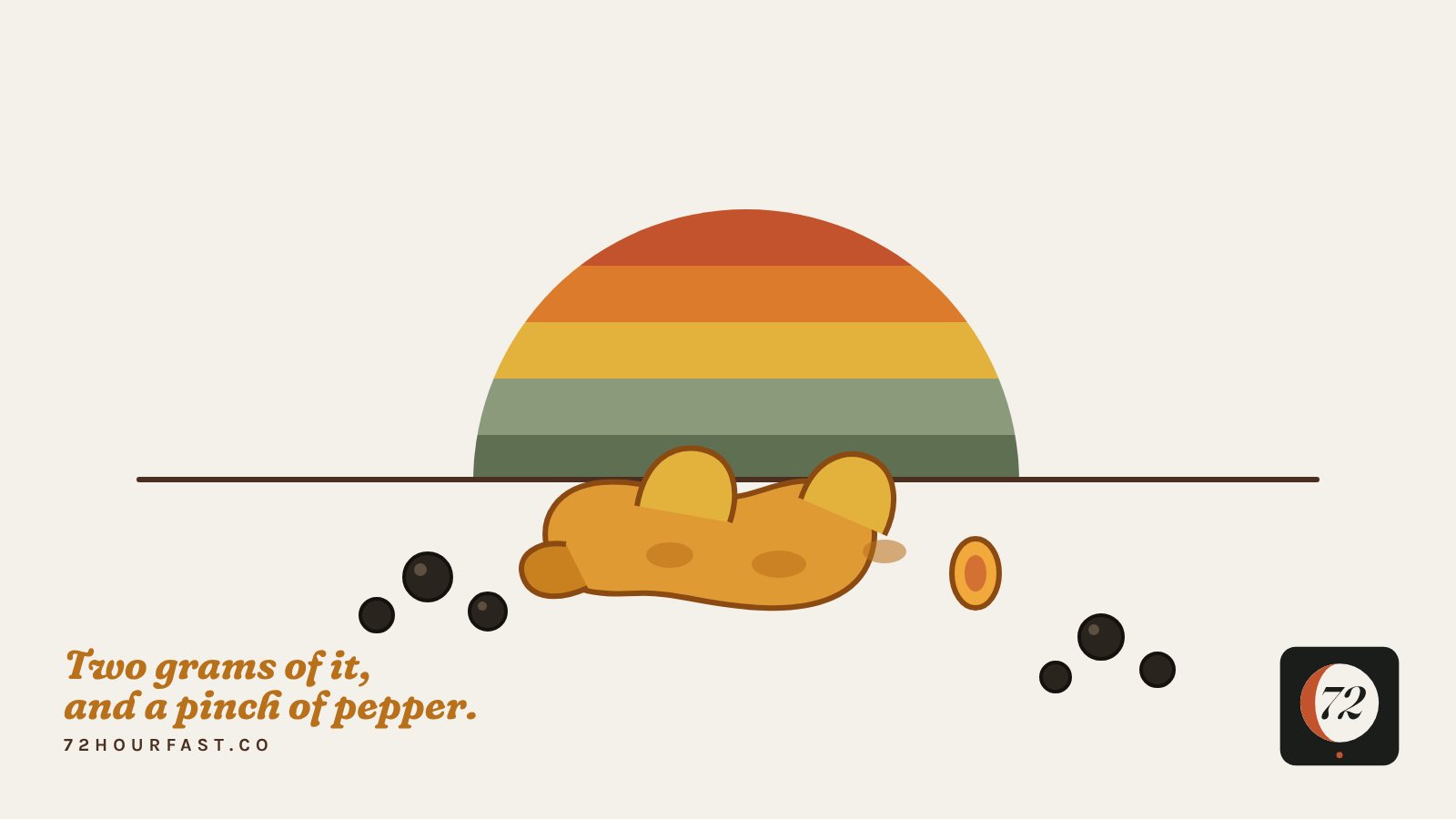
Two grams of turmeric a day, give or take, with black pepper. I started during the recovery from my knee surgeries, when I was stiff and sore and fed up, and I’ve carried on since.
Has it helped? I think so. Mornings got easier over a few months. The stiffness that used to take an hour to shake off takes less.
Now hold that thought, because I’m going to spend the rest of this post testing it.
Why the black pepper
Turmeric has a problem: on its own, almost none of it gets into you. It goes in one end and out the other largely untouched.
Black pepper contains piperine, which blocks the enzymes that break curcumin down before it’s absorbed. In 1998 a study gave volunteers two grams of curcumin with and without 20mg of piperine and reported a 2,000 per cent increase in how much got into the blood. That number is on every turmeric bottle in Britain.
Here’s what isn’t on the bottle. The human part of that study was eight people. And in the twenty-eight years since, almost nobody has reproduced anything like 2,000 per cent. Later work puts the real-world improvement somewhere between fifty and a hundred and fifty per cent, and some analyses lower still.
So pepper helps. It helps a lot less than the label suggests. A pinch is plenty, about a twentieth of a teaspoon.
What the evidence says about joints
Better than I expected, and shakier than it first looks.
The headline reviews are genuinely positive. A 2024 umbrella analysis concluded that curcumin relieves pain, improves stiffness and mobility, and cuts how much other medication people need. Another the same year found it beat placebo for knee arthritis and came out comparable to anti-inflammatory drugs.
Then, at the start of this year, somebody did the unglamorous job of grading the quality of those reviews. Seven of them, forty-eight separate findings. Four carried a high risk of bias. Of the forty-eight findings, five were medium quality, six were low, and thirty-seven were rated extremely low.
Both things are true. The direction of the evidence is positive and the foundations under it are soft. That’s not a reason to throw the turmeric away. It is a reason not to tell you it’s proven.
So is it the curcumin, or is it me?
This is the interesting part, and it’s the question I’d rather ask than dodge.
Pain is the single most placebo-responsive thing there is. And here’s the part that stopped me: placebos work even when people are told they’re placebos. In a trial of chronic back pain, patients given capsules clearly labelled as containing nothing, and told so, reported about fifteen per cent less pain than those given nothing at all. A review of thirteen such studies, nearly eight hundred people, found the effect holds up.
It’s not uncontested. The trials are small, early research publishes its wins more readily than its failures, and one critic pointed out that in the back pain study the placebo group got large orange capsules while the control group got nothing, which raises expectations all by itself.
But take it seriously for a moment. If a pill with nothing in it reduces real pain by fifteen per cent when you know it’s empty, then a daily ritual involving a spice with at least some evidence behind it is not nothing, whatever’s doing the work.
I’d rather say that honestly than pretend I can tell the difference. I can’t. My knee is better. Some of that is time, some is the curcumin, some is almost certainly me expecting it to help. I’m not sure that last part is a problem.
The part I’d have wanted to know in 2017
The cheek goes quiet here.
If you take warfarin or any blood thinner, do not start turmeric supplements without asking your doctor. New Zealand’s drug safety people issued a formal warning about this in 2018. There’s a documented case of a patient’s INR going above 10 within weeks of starting turmeric, which is a serious bleeding risk. The warning is about supplements, not the turmeric in your curry.
I was on warfarin when I started taking it. Nobody told me, and I didn’t know to ask.
And there’s a liver signal. Cases of liver injury linked to turmeric supplements have been accumulating. A 2023 American study tracked them rising. A UK expert statement last year found reasonable evidence of a link, including rare cases below the official safe intake. Germany’s risk assessment institute flagged that the problem looks worse in the enhanced-absorption formulations — which is to say, the ones with black pepper in them. The ones I take. Over seventy per cent of cases carry one particular gene variant, which is probably why it’s rare and unpredictable. Symptoms usually appear two to eight weeks in.
So: turmeric in food, fine. Turmeric in capsules at supplement strength, with pepper, for months on end, is a drug by any sensible definition and deserves the same respect. If you’re on anything prescribed, if you’ve had liver or gallbladder trouble, or if you go yellow or feel unwell after starting, stop and see a doctor.
Where this sits with fasting
In the eating window, with food and fat, because that’s how it absorbs best.
And the honest frame: fasting itself is the stronger anti-inflammatory lever here. Turmeric is the small thing I do alongside it. Not the other way round.
Greg x
Where the numbers came from. The piperine figure is Shoba and colleagues in Planta Medica, 1998, with the later bioavailability work that followed it. The joint findings are from two 2024 umbrella reviews and a 2026 critical appraisal that graded their quality. The open-label placebo figures come from the Harvard-led back pain trial and the 2021 review of thirteen such studies. The warfarin warning is from New Zealand’s Centre for Adverse Reactions Monitoring, 2018. The liver findings are from the US Drug-Induced Liver Injury Network, a 2024 UK expert statement, and Germany’s Federal Institute for Risk Assessment.
If this was useful. The 72-Hour Fast is out now, with a free twelve-week PDF journal. If you’re starting out, the 7-Day Planner is free, and so is the timer.
This is a blog, not medical advice, and nothing on it treats or diagnoses anything. Nothing here is a reason to stop, start or change a prescribed medicine — that’s a conversation with your GP. Please read the Sensible Bit before you fast. If you’re unwell and getting worse, call 111, or 999 in an emergency.


Leave a Reply